
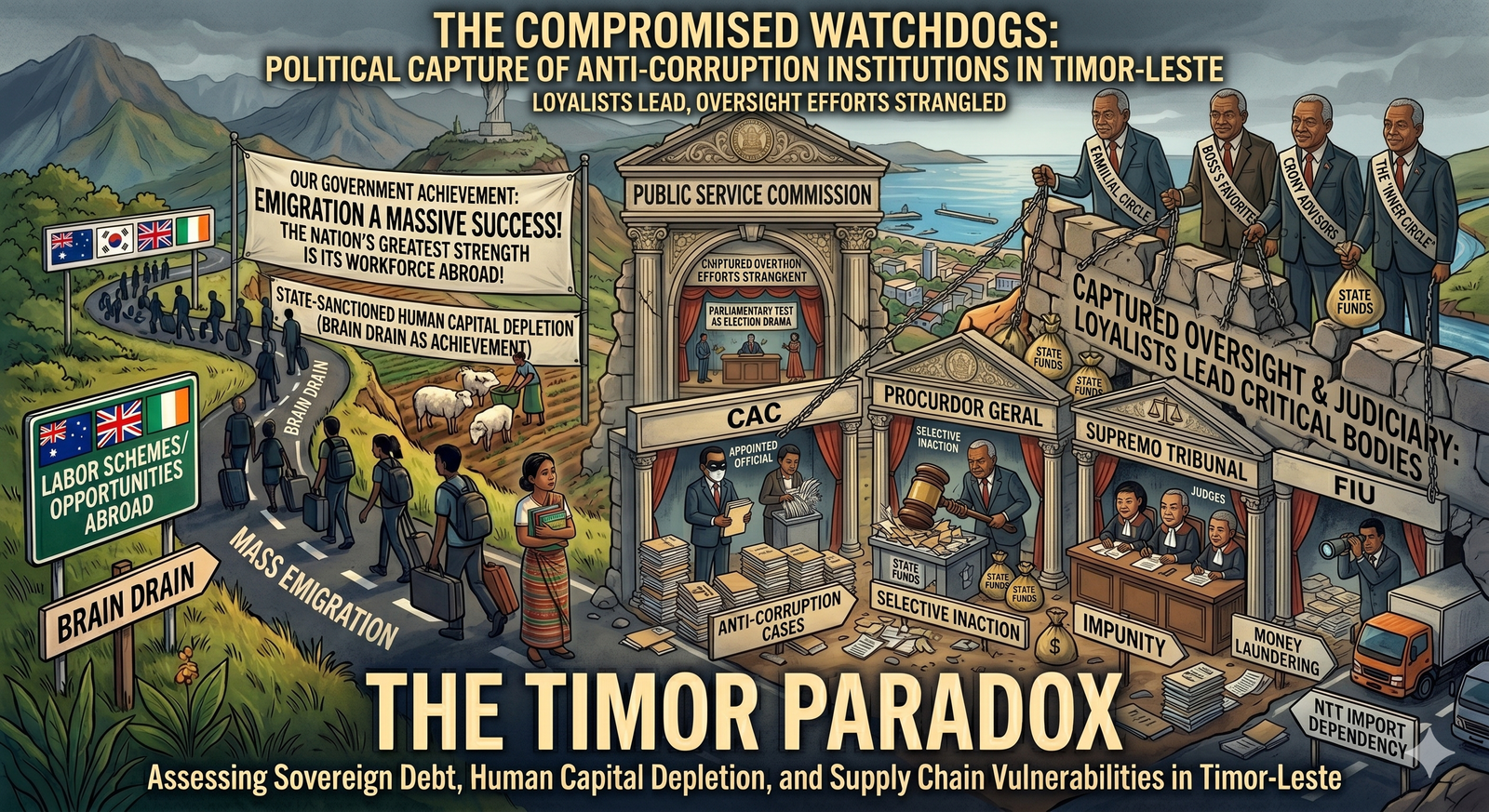
The structural erosion of Timor-Leste's public sector is heavily intensified by a critical systemic flaw: the near-total political capture of the state's primary oversight and monitoring institutions. While a robust anti-corruption framework requires independent watchdogs to hold power to account,22.Law No. 8/2009: Anti-Corruption Commission Law. Art. 3(1-2): technical independence and administrative autonomy; Art. 5(1): independent from any person or authority.click number to jump to full reference the current political architecture ensures these regulatory bodies operate under the direct influence of elite networks.8,148.Scheiner C. The political economy of accountability in Timor-Leste. Public Administration and Development. 2011;30(5).
14.Lowy Institute. Timor-Leste's governance dilemma: fear, accountability, and risk. The Interpreter. 2026 Jan 20.click number to jump to full reference
By analyzing the appointment mechanisms of key judicial and regulatory posts, it becomes clear how systemic conflicts of interest directly impede the state's capacity to combat corruption.1,61.Constitution of Timor-Leste 2002. Art. 86(j): President appoints President of Supreme Court; Art. 86(k): President appoints Prosecutor-General.
6.Weber A, Lo K. An introduction to constitutional law in Timor-Leste. Stanford / USAID; 2012.click number to jump to full reference
1. The Political Appointment Mechanism of State Watchdogs
In a functioning system of checks and balances, control institutions must maintain absolute operational and political neutrality.66.Weber A, Lo K. An introduction to constitutional law in Timor-Leste. Stanford / USAID; 2012.click number to jump to full reference In Timor-Leste, however, the leadership of major oversight bodies is structurally bound to the ruling political coalitions by the Constitution itself.11.Constitution of Timor-Leste 2002. Art. 86(j) and Art. 86(k) on Presidential appointment powers.click number to jump to full reference
▼
▼
▼
The top leadership positions of the three critical regulatory bodies are directly subject to political intervention:
- The Anti-Corruption Commission (CAC): Tasked with investigating criminal corruption, its Commissioner is elected by the National Parliament, making the position directly dependent on prevailing political majorities.2,32.Law No. 8/2009: Anti-Corruption Commission Law. Commissioners elected by National Parliament.
3.Government of Timor-Leste. New Commissioner of the CAC takes office. Dili; 2024 Jul 5. Elected by 41 votes, 24 June 2024.click number to jump to full reference In April 2024, Parliament further amended the law to allow appointment and dismissal of the CAC Commissioner by absolute majority vote — removing the prior requirement that at least three-quarters of legislators be present. Opposition members argued the change was hastily adopted and would weaken the rule of law.44.Freedom House. Timor-Leste: Freedom in the World 2025 Country Report. Washington DC; 2025.click number to jump to full reference - The Prosecutor-General (Procurador-Geral da República): Under Article 86(k) of the Constitution, the Prosecutor-General is appointed by the President of the Republic for a term of four years11.Constitution of Timor-Leste 2002. Art. 86(k): Prosecutor-General appointed by President for a four-year term.click number to jump to full reference — a process formally independent but in practice shaped by executive nomination dynamics and prevailing political coalitions.
- The Supreme Court of Justice (Supremo Tribunal de Justiça): Under Article 86(j) of the Constitution, the President of the Supreme Court is appointed by the President of the Republic from among the court's judges — a composition process requiring National Parliament confirmation and Presidential appointment.1,51.Constitution of Timor-Leste 2002. Art. 86(j): President appoints President of Supreme Court from among its judges.
5.Wikipedia. Timor-Leste Supreme Court of Justice. Composition: nominated by Superior Council for Judicial Magistrates, with Parliamentary confirmation and Presidential appointment.click number to jump to full reference
2. The Parliamentary 'Fit and Proper' Filter: Bureaucratic Theater
Before these institutional leaders assume office, they must pass a parliamentary screening known as a "fit and proper" test. While legally designed as an objective evaluation of technical competence, ethics, and administrative merit,66.Weber A, Lo K. An introduction to constitutional law in Timor-Leste. Stanford / USAID; 2012.click number to jump to full reference this process functions primarily as political theater.
Rather than serving as a rigorous mechanism to filter out partisan bias, the legislative screening operates as a rubber-stamping exercise for pre-negotiated elite agreements.88.Scheiner C. The political economy of accountability in Timor-Leste. Public Administration and Development. 2011;30(5):350–361.click number to jump to full reference Candidates are selected based on their willingness to navigate within existing patronage networks rather than their determination to dismantle them. The public hearings provide symbolic legitimacy to appointments that are fundamentally transactional.7,127.SEA Anti-Corruption Network. Corruption eroding Timor-Leste. Bangkok: SEAANTICORRUPTION.org; 2025 Mar 21.
12.Lopes AG et al. The role of the CAC in combating organized corruption in Timor-Leste. IJSMR. 2025;3(2).click number to jump to full reference The 2024 amendment reducing the legislative threshold for CAC appointments — denounced by the opposition as an attack on the rule of law — stands as a concrete illustration of this dynamic.44.Freedom House. Timor-Leste: Freedom in the World 2025 Country Report. Washington DC; 2025.click number to jump to full reference
Consequently, although a legal framework supporting good governance principles exists, its implementation is consistently hindered by resource limitations, limited institutional capacity, and strong political influence.1212.Lopes AG et al. The role of the CAC in combating organized corruption in Timor-Leste. IJSMR. 2025;3(2).click number to jump to full reference These institutions rarely pursue high-level corruption or investigate the insular "inner circles" of ruling party leadership.1111.Tatoli National News Agency. Political dynamics of fighting corruption in Timor-Leste. Dili: Tatoli; 2024 Jul 5.click number to jump to full reference
3. Structural Immunity and the Normalization of Impunity
The direct alignment of these oversight bodies with political networks creates a highly specialized vulnerability: systemic institutional paralysis. When investigators (CAC), prosecutors (Procurador-Geral), and judges (Supremo Tribunal) owe their appointments to political patronage, the legal system becomes an instrument for selective enforcement.8,148.Scheiner C. The political economy of accountability in Timor-Leste. Public Administration and Development. 2011;30(5).
14.Lowy Institute. Timor-Leste's governance dilemma: fear, accountability, and risk. The Interpreter. 2026 Jan 20.click number to jump to full reference
Despite improvements in recent years, concerns over judicial independence persist for politically sensitive cases. Political and religious interference in the judicial system has been reported.99.Freedom House. Timor-Leste: Freedom in the World 2024 Country Report. Only 35 judges covering the entire country.click number to jump to full reference The UNDP's 2024 justice sector analysis found only 28 judges operating at first instance and 4 at the High Court — a systemic under-resourcing that compounds case backlogs and creates structural conditions for selective enforcement.1313.UNDP Timor-Leste. Analysis and recommendations for improving the justice sector in Timor-Leste. Dili: UNDP; 2024 Dec.click number to jump to full reference
Public perceptions of impunity have persisted across reporting periods. There is widespread belief that members of politically connected groups enjoy substantial impunity, and that reporting abuse would lead to retaliation rather than positive change.1010.U.S. Department of State. 2024 Country Reports on Human Rights Practices: Timor-Leste. Washington DC; 2025.click number to jump to full reference From 2011 to 2022, the CAC investigated 398 corruption cases with 856 suspects, identifying state damage of USD 24.8 million — a figure strikingly small relative to the scale of public expenditure over the same period.1111.Tatoli. Political dynamics of fighting corruption in Timor-Leste. Dili: Tatoli; 2024 Jul 5. State damage identified at USD 24,849,050.83.click number to jump to full reference
Regional analysis warns that Timor-Leste's trajectory mirrors Cambodia's: constitutional amendments and legal restructuring justified in the name of stability and efficiency, yet gradually weakening judicial independence and entrenching elite dominance — political predictability at the cost of accountability.1414.Lowy Institute. Timor-Leste's governance dilemma: fear, accountability, and risk. The Interpreter. Sydney; 2026 Jan 20.click number to jump to full reference
4. The Exit Strategy: Capital Flight and Institutional Cynicism
The political capture of these watchdog institutions creates a profound sense of institutional cynicism among the populace, directly driving the country's severe brain drain.15,1615.Bertelsmann Stiftung. Timor-Leste Country Report 2026. BTI Transformation Index. Gütersloh; 2026.
16.Kingsbury D. Precarity and pride prevalent in Timor-Leste's 2024. East Asia Forum. ANU; 2024 Feb 20.click number to jump to full reference
When young professionals, academics, and tech-literate citizens recognize that meritocracy is structurally absent — and that the very institutions built to protect fairness are managed by politically appointed loyalists — domestic advancement becomes rationally untenable.1717.Lowy Institute. Timor-Leste's youth leave or get left behind. The Interpreter. Sydney; 2019.click number to jump to full reference In November 2023, there were more Timorese migrants in Australia than ever before — 5,281 in total, with 914 having left the PALM scheme to apply for asylum in order to access a bridging visa that allowed freedom to work outside scheme restrictions.1616.Kingsbury D. Precarity and pride prevalent in Timor-Leste's 2024. East Asia Forum. ANU; 2024 Feb 20.click number to jump to full reference
▼
▼
In 2023, Timor-Leste returned to the World Bank's list of fragile states — a designation that reflects not merely fiscal stress but institutional fragility.1515.Bertelsmann Stiftung. Timor-Leste Country Report 2026. BTI; 2026. 2023 return to World Bank fragile states list.click number to jump to full reference The state's celebration of migration as a programmatic triumph reveals a deeper structural logic: by facilitating the departure of the demographics most likely to demand transparency and institutional accountability, the political elite insulates its patronage networks from internal resistance, securing control over a diminishing pool of public funds.8,148, 14.Scheiner 2011; Lowy Institute governance dilemma analysis, 2026.click number to jump to full reference
What failed in Timor-Leste's political crises was not the Constitution — it was elite compliance: the refusal to respect institutional boundaries and selective adherence to the rule of law.1414.Lowy Institute. Timor-Leste's governance dilemma: fear, accountability, and risk. The Interpreter. Sydney; 2026 Jan 20.click number to jump to full reference