
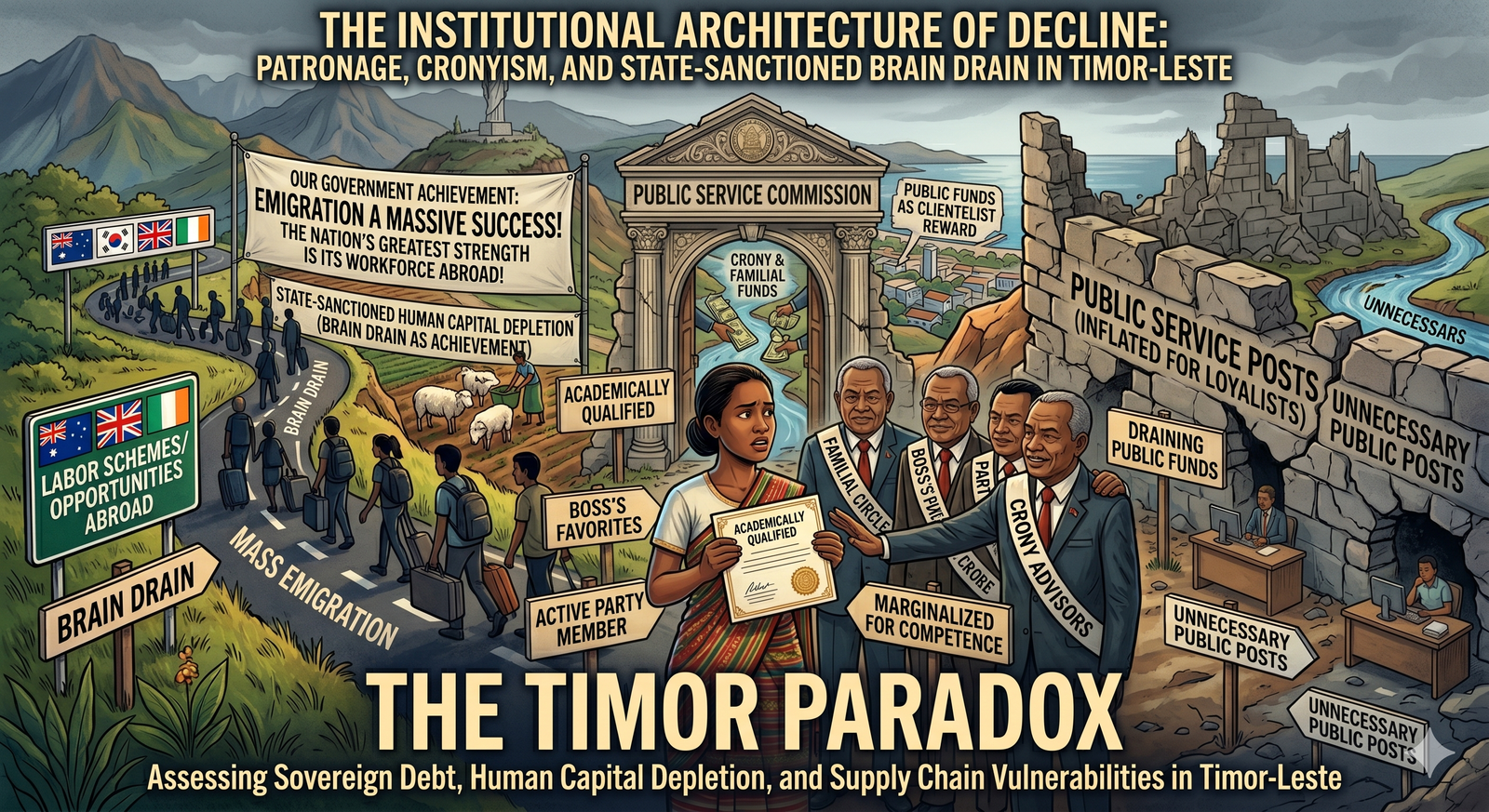
The critical crossroad facing Timor-Leste is not merely a product of deteriorating natural resource reserves; it is fundamentally an institutional crisis. While the impending depletion of the Petroleum Fund illustrates a severe fiscal cliff, the mechanisms exacerbating this collapse are deeply rooted in the country's political architecture.2,72.World Bank. Timor-Leste Public Expenditure and Financial Accountability Assessment 2018. doi:10.1596/33896.
7.Scheiner C. The political economy of accountability in Timor-Leste. Public Administration and Development. 2011;30(5).click number to jump to full reference Structural vulnerabilities within the state are amplified by deep-seated patronage networks, systemic and underreported corruption, familial cronyism, and a policy paradigm that misinterprets mass human capital flight as a governmental success.3,43.Freedom House. Timor-Leste: Freedom in the World 2022 Country Report. Washington DC: Freedom House; 2022.
4.Transparency International. Corruption Perceptions Index 2024. Timor-Leste CPI score: 44/100; rank: 73rd of 180 countries.click number to jump to full reference
1. The Deconstruction of Meritocracy (Pre-2015)
The early development of Timor-Leste's public administration was legally framed around the principles of neutrality and competency. The Civil Service Act 2004 was explicitly codified to institutionalize hiring based on merit, protect administrative integrity, and establish a clear separation between public bureaucracy and political governance.11.Fenby S. Re-building the state: public administration in Timor-Leste. Policy and Society. 2006;25(1):178–189.click number to jump to full reference
However, a stark divergence between legal framework and practical execution quickly emerged. Up until roughly 2015, the political elite increasingly marginalized the merit principle, co-opting political critics and rewarding party loyalty through public sector job creation.1,71.Fenby S. Re-building the state: public administration in Timor-Leste. Policy and Society. 2006;25(1).
7.Scheiner C. The political economy of accountability in Timor-Leste. Public Administration and Development. 2011;30(5).click number to jump to full reference This systematic inflation of unnecessary public service positions turned the state apparatus into a massive clientelist network:
▼
▼
▼
Public financial management assessments have identified weak accountability mechanisms and limited transparency in procurement as persistent structural vulnerabilities within Timor-Leste's public financial management system.22.World Bank. Timor-Leste Public Expenditure and Financial Accountability Assessment 2018. doi:10.1596/33896.click number to jump to full reference Public funds that should have been channeled into capital investments — such as primary agricultural infrastructure or local manufacturing — were instead drained by an ever-expanding state payroll, locking the nation into a highly distorted equilibrium.1,71, 7.Fenby 2006; Scheiner 2011 — on structural patronage and fiscal distortion.click number to jump to full reference
2. The Era of Familial Cronyism and the 'Inner Circle' (Post-2015)
From 2015 onward, the erosion of administrative integrity underwent a structural mutation. The baseline issue of political party clientelism deteriorated into localized familialism, cronyism, and elite capture.77.Scheiner C. The political economy of accountability in Timor-Leste. Public Administration and Development. 2011;30(5).click number to jump to full reference The Civil Service Commission — nominally inaugurated in May 2015 with a mandate of impartiality88.Government of Timor-Leste. President and Commissioners of Civil Service Commission sworn into office. Dili; 2015 May 29.click number to jump to full reference — was structurally vulnerable from the outset: by law, Commissioners are appointed by the Prime Minister, creating an inherent conflict between independence and executive accountability.
The Dynamics of Exclusion
This shift has created a frustrating paradox for the nation's emerging intellectual class. An individual can be highly qualified academically, possess specialized professional skills, and even be a loyal member of the ruling political apparatus — yet if they lack direct lineage, marital ties, or deep personal history with the inner elite circle, they are systematically excluded from key leadership positions.77.Scheiner C. The political economy of accountability in Timor-Leste. Public Administration and Development. 2011;30(5).click number to jump to full reference
The World Bank estimates that Timor-Leste loses from 1.5 to 2 percent of gross domestic product annually to corruption. Anti-corruption bodies lack sufficient funding to operate effectively.33.Freedom House. Timor-Leste: Freedom in the World 2022 Country Report. Washington DC: Freedom House; 2022.click number to jump to full reference Research covering the period 2020–2023 confirms that while a legal framework supporting good governance principles exists, its implementation is consistently hindered by resource limitations, limited institutional capacity, and strong political influence.66.Lopes AG et al. The role of the Anti-Corruption Commission (CAC) in combating organized corruption in Timor-Leste. IJSMR. 2025;3(2).click number to jump to full reference The consequence is a public sector severely lacking in technical capability at the exact moment it faces an existential macroeconomic crisis.4,54.Transparency International. Corruption Perceptions Index 2024. CPI score: 44/100.
5.SEA Anti-Corruption Network. Corruption eroding Timor-Leste: between hopes and challenges. 2025 Mar.click number to jump to full reference
3. The Rationalization of Mass Brain Drain
Perhaps the most troubling feature of Timor-Leste's structural decline is the political rationalization of its human capital flight. Facing a stagnant domestic economy suffocated by nepotism, tens of thousands of young, highly motivated Timorese citizens migrate abroad annually.10,1210.IOM. Migration in Timor-Leste: a country profile 2019. Geneva: IOM; 2023.
12.Lowy Institute. Timor-Leste's youth leave or get left behind. The Interpreter. Sydney; 2019.click number to jump to full reference They primarily join low-skilled labor frameworks like the Pacific Australia Labour Mobility (PALM) scheme or relocate to jurisdictions such as South Korea, Ireland, and the United Kingdom.1414.Government of Timor-Leste / WTO. National Employment Strategy 2017–2030. Dili: SEPFOPE; 2017.click number to jump to full reference
About 65 percent of Timor-Leste's population is under 35 — yet the labour force participation rate stands at merely 30.5 percent, compared to 66.1 percent across Southeast Asia, with youth unemployment rates nearly double the national average.1313.Heinrich Böll Foundation. The power and potential of Timor-Leste's youth in economic diversification. Bangkok: HBS; 2023.click number to jump to full reference Young people between 15 and 24 made up 20 percent of the total population in 2015, yet accounted for more than two-thirds of unemployment in the country.1212.Lowy Institute. Timor-Leste's youth leave or get left behind. The Interpreter. Sydney; 2019.click number to jump to full reference In standard development economics, this scale of demographic draining is classified as an acute institutional failure — a symptom of an economy incapable of generating sustainable livelihood options for its youth.1616.World Bank. Youth unemployment rate for Timor-Leste [SLUEM1524ZSTLS]. World Development Indicators; 2026.click number to jump to full reference
The Political Distortion: Rather than treating this massive hemorrhage of physical and intellectual strength as a national crisis, the state apparatus consistently champions it as a major governmental achievement and a metric of policy success.1111.IOM and Timor-Leste partner to develop migration profile for evidence-based policymaking. Geneva: IOM; 2023 Apr 18.click number to jump to full reference
Both qualified and unqualified workers are leaving under the PALM scheme, contributing to labour and brain drains whose long-term demographic, economic, and social impacts remain insufficiently analysed.1515.The Australia Institute. The PALM scheme: labour rights for our Pacific partners. Canberra; 2023 Dec.click number to jump to full reference By framing the relocation of its workforce abroad as a programmatic triumph, the government benefits from an immediate economic safety valve — while the export of young, critical voices effectively insulates the ruling elite from domestic political accountability.10,1110–11.IOM country profile 2019; IOM-Timor-Leste partnership on migration evidence, 2023.click number to jump to full reference
4. Institutional Solutions and Structural Alternatives
To arrest this slide toward institutional and financial breakdown, Timor-Leste must dismantle its centralized system of political patronage and implement structural alternatives across three core areas.
A. Total Insulation of the Civil Service Commission
The Civil Service Commission (CSC) must be granted complete budgetary and structural independence from the office of the Prime Minister to eliminate political appointments.8,98.Government of Timor-Leste. Civil Service Commission sworn into office. Dili; 2015 May 29.
9.UNDP Timor-Leste. Enhancing public sector accountability through institutional strengthening. Dili: UNDP; 2017.click number to jump to full reference
B. Legalizing Anti-Nepotism Frameworks
The state must establish strict, enforceable anti-nepotism statutes that carry severe criminal penalties for public officials.66.Lopes AG et al. The role of the CAC in combating organized corruption in Timor-Leste. IJSMR. 2025;3(2).click number to jump to full reference Bar immediate and extended family members of elected officials from holding appointed public offices, securing government procurement contracts, or leading state-owned enterprises.
C. Reorienting Human Capital from 'Export' to 'Equity'
The state must fundamentally change its perspective on youth labor migration.1717.Government of Timor-Leste. National Diaspora Engagement Policy 2023–2027. Dili: Ministry of Foreign Affairs; 2022.click number to jump to full reference Timor-Leste's National Diaspora Engagement Policy 2023–2027, developed with IOM and UNDP support, positions diaspora communities as critical agents of socio-economic development1111.IOM and Timor-Leste partner to develop migration profile for evidence-based policymaking. Geneva: IOM; 2023.click number to jump to full reference — but requires structural backing to move from policy aspiration to institutional reality.
17.National Diaspora Engagement Policy 2023–2027. Dili: Ministry of Foreign Affairs; 2022.click number to jump to full reference
Without these foundational changes, the combination of a shrinking Petroleum Fund, an insulated political class, and a state-sanctioned exit of its finest youth ensures that Timor-Leste's nominal political independence will continue to be hollowed out by economic insolvency and structural dependency.2,4,72, 4, 7.World Bank PEFA 2018; Transparency International CPI 2024; Scheiner 2011.click number to jump to full reference