
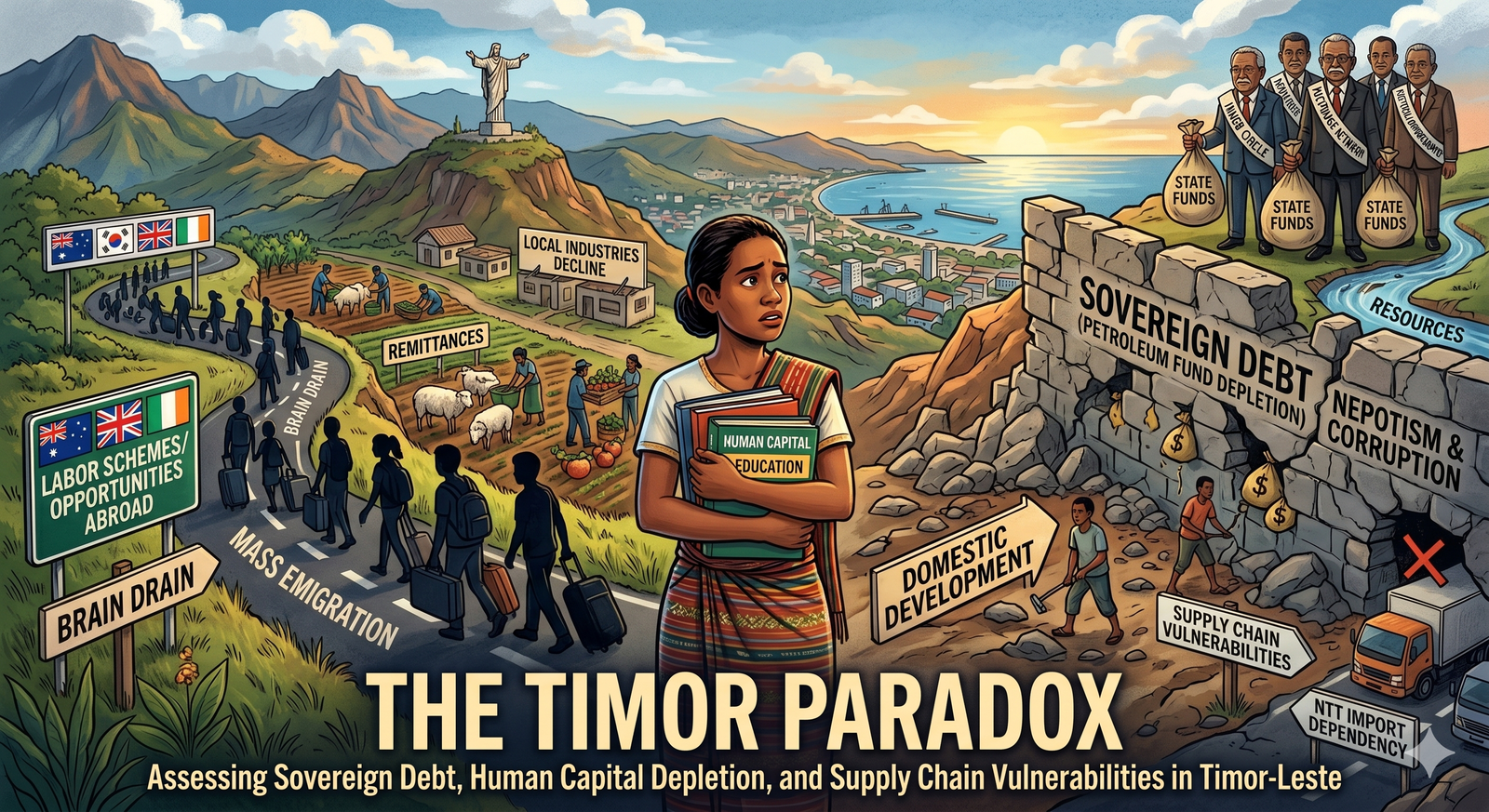
The socio-economic trajectory of Timor-Leste stands at a critical juncture. Emerging from its independence in 2002, the nation built its fiscal foundations on a single, non-renewable resource: oil and gas. However, contemporary data indicates that the sovereign state is rapidly approaching a structural economic boundary often referred to as a "fiscal cliff."1,41.IMF Country Report No. 25/278 — 2025 Article IV Consultation with Timor-Leste.
4.Kingsbury D. Timor-Leste's financial cliff draws closer in 2025. East Asia Forum, 2025.click number to jump to full reference
This article explores the tri-fold systemic challenges facing Timor-Leste — sovereign asset depletion, skilled labor migration (brain drain), and deep asymmetrical supply chain dependencies — while offering structurally viable alternatives to secure its long-term sovereignty.
1. The Mechanics of the Impending Fiscal Cliff
The economic baseline of Timor-Leste operates under an extractive dependency. For more than two decades, the national budget has been heavily funded by the Petroleum Fund (PF), which was largely capitalized by the Bayu-Undan oil and gas field.
As of mid-2025, the Petroleum Fund held a balance of approximately USD 18.74 billion — roughly ten times the country's non-oil GDP, making it one of the largest sovereign funds relative to domestic economy size in the world.2,32.BCTL Petroleum Fund Quarterly Report Q1 2025. Fund balance USD 18.74 billion as of June 2025.
3.Lowy Institute. The oil shock to Timor-Leste's economy. The Interpreter, 2026.click number to jump to full reference However, this wealth is now static: Bayu-Undan, which generated the vast majority of the Fund's deposits, has reached the end of its productive life, with production ceasing in 2025.33.Lowy Institute. The oil shock to Timor-Leste's economy. The Interpreter, 2026.click number to jump to full reference The IMF's 2025 Article IV Consultation projects that if the government continues its current spending trajectory, the Petroleum Fund will be fully depleted by the end of the 2030s,1,61.IMF Country Report No. 25/278 — 2025 Article IV Consultation.
6.IMF Press Release No. 25/315 — Executive Board Concludes 2025 Article IV Consultation with Timor-Leste.click number to jump to full reference posing existential risks to fiscal sustainability.
Real GDP grew by 4.1 percent in 2024, driven by infrastructure spending — yet capital expenditure remains below pre-COVID levels, and financing continues to rely heavily on PF withdrawals.55.World Bank. Timor-Leste Macro Poverty Outlook 2026.click number to jump to full reference Timor-Leste relies overwhelmingly on these withdrawals, which in 2023 equalled 88 percent of the country's GDP.44.Kingsbury D. Timor-Leste's financial cliff draws closer in 2025. East Asia Forum, 2025.click number to jump to full reference Since 2008–09, the government has exceeded sustainable withdrawals almost every year.
The Greater Sunrise Gridlock
The primary alternative to offset this depletion is the development of the Greater Sunrise gas fields. The field — estimated to hold over USD 33 billion worth of gas — remained stalled at the end of 2024, with the government holding a 56.6 percent stake.44.Kingsbury D. Timor-Leste's financial cliff draws closer in 2025. East Asia Forum, 2025.click number to jump to full reference Monetization remains blocked by structural disagreements:
- The Timorese Position: Mandating domestic processing at the proposed Tasi Mane petroleum hub on the southern coast, to cultivate a domestic industrial base.
- The Commercial Position: Operator Woodside Petroleum proposed back-filling pipelines for processing near Darwin in Australia's Northern Territory, or alternatively offshore processing,44.Kingsbury D. Timor-Leste's financial cliff draws closer in 2025. East Asia Forum, 2025.click number to jump to full reference citing lower capital expenditure and decreased execution risk.
2. Geopolitical Asymmetry and Capital Flight
As a young state positioned within a highly contested maritime boundary, Timor-Leste's fiscal precarity makes it a focal point for regional competition between Western interests (primarily Australia) and Chinese capital investment.
Timor-Leste offers significant strategic benefits to China, not least being its proximity to straits that give access to the Indian Ocean — a matter of direct concern to Australia, whose exclusive economic zone is directly adjacent to Timorese waters.99.Australian Naval Institute. China, Australia, and Timor-Leste. Naval Institute Analysis, 2026.click number to jump to full reference From a structural realist perspective, Australia's strategic interest focuses on maintaining regional alignment and avoiding a security vacuum in its immediate northern approaches.
Chinese state-backed firms have demonstrated a clear appetite for infrastructure development, with Timor-Leste an active supporter of China's regional and global initiatives.88.Huang J. China's Engagement with Timor-Leste Amid Geopolitical Tensions. RSIS Commentary, NTU, 2024.click number to jump to full reference However, Timor-Leste's limited size and weaker economy cannot sustain the consequences of poor investment decisions; high levels of debt incurred by Kenya, Sri Lanka, and Zambia from Chinese borrowing have raised concerns within Dili.88.Huang J. China's Engagement with Timor-Leste Amid Geopolitical Tensions. RSIS Commentary, NTU, 2024.click number to jump to full reference
When a state with limited fiscal capacity uses debt instruments to build large, underutilized infrastructure projects — such as airport renovations and port facilities — it creates structural vulnerabilities:8,108.Huang J. China's Engagement with Timor-Leste Amid Geopolitical Tensions. RSIS, 2024.
10.The Diplomat. Why Did Timor-Leste Sign a Comprehensive Strategic Partnership With China? 2023.click number to jump to full reference
▼
▼
▼
▼
Analysts caution that framing Timor-Leste's strategic options purely within a geopolitical lens may not serve either Australia's or Dili's best interests — Timor-Leste is ultimately a country seeking development partners, not a pawn in great-power competition.1010.The Diplomat. Why Did Timor-Leste Sign a Comprehensive Strategic Partnership With China? 2023.click number to jump to full reference
3. The Human Capital Deficit: The PALM Scheme
Compounding the fiscal crisis is a severe demographic challenge. Due to high domestic unemployment, Timor-Leste relies heavily on the Pacific Australia Labour Mobility (PALM) scheme. This bilateral framework allows Timorese citizens to fill structural labor deficits within Australia's agricultural and meat-processing sectors, with workers remitting an average of AUD 1,500 per month back to their families.1313.DFAT. Pacific Australia Labour Mobility (PALM) Scheme Fact Sheet. Canberra: DFAT; 2025 Feb.click number to jump to full reference
As of November 2025, Timor-Leste was the second-largest PALM sending country, with 5,205 workers employed in Australia — predominantly in abattoirs and agricultural facilities.1212.Mares P. Improving PALM: The Pacific Australia Labour Mobility Scheme. 2025.click number to jump to full reference While the microeconomic impacts are positive, the macroeconomic outcomes present structural risks:
- Brain and Brawn Drain: Both qualified and unqualified workers are leaving, contributing to labour and brain drains whose long-term demographic, economic, and social impacts are yet to be carefully analysed.1111.The Australia Institute. The PALM Scheme: Labour Rights for Our Pacific Partners. 2023.click number to jump to full reference
- Industrial Stagnation: By routing the country's prime working-age cohort into foreign primary production, the domestic economy is deprived of the human capital required to build local manufacturing or service sectors.
- Welfare Dependency: Migration pessimists argue that remittances fuel conspicuous consumption of imported goods rather than productive enterprise, aggravating underdevelopment and encouraging structural dependency.1414.The Diplomat. Does Migration Help or Hinder Timor-Leste's Development? 2019.click number to jump to full reference
4. Supply Chain Vulnerabilities: The NTT Dependency
While international discourse focuses on maritime security and debt, Timor-Leste's immediate physical survival is tied to its land border with Indonesia's Nusa Tenggara Timur (NTT) province. Both economies have very low incomes and predominantly rural populations, and both are at early stages of development with limited regional trade linkages.1717.ADB. Trade and Growth Horizons for Nusa Tenggara Timur and Timor-Leste. Manila: ADB.click number to jump to full reference
Official trade statistics reveal the depth of this asymmetry. In December 2023, Timor-Leste received 99.37 percent of NTT's monthly exports, channeled through the Atambua State Border Post — representing the dominant destination for virtually all provincial export activity.1515.BPS-NTT. Neraca Perdagangan Nusa Tenggara Timur, December 2023. Kupang: BPS; 2024 Feb.click number to jump to full reference Annual NTT export data for 2024 confirms the Atambua land border accounted for 68.62 percent of total provincial exports, with Timor-Leste remaining the primary recipient.1616.BPS Kabupaten Kupang. Neraca Perdagangan NTT, December 2024. Kupang: BPS; 2025 Feb.click number to jump to full reference
Systemic Risk Factor: Timor-Leste possesses a low buffer capacity for logistical disruptions. If the border corridors or shipping lanes between NTT and Dili experience a prolonged closure, local markets face acute inflationary shocks and supply failures within days.15,1615–16.BPS-NTT trade data, 2023–2024.click number to jump to full reference
5. Structural Alternatives and Policy Solutions
To mitigate the risk of fiscal insolvency and maintain economic autonomy, structural reforms must be implemented across three core areas.
A. Borderland Industrialization and Import Substitution
Instead of acting merely as a passive consumer of imports, Timor-Leste should cooperate with Indonesia to establish Special Economic Zones (SEZs) along the Atambua-Dili corridor.1717.ADB. Trade and Growth Horizons for Nusa Tenggara Timur and Timor-Leste.click number to jump to full reference
B. Strategic Realignment of Human Capital
The state must transform its labor export strategy from a temporary relief mechanism into an institutional upskilling pipeline.11,1211–12.The Australia Institute PALM report; Mares, Improving PALM, 2025.click number to jump to full reference
C. Resource Monetization Realism
The state must resolve the Greater Sunrise gridlock before sovereign reserves reach a critical tipping point.1,4,61, 4, 6.IMF Country Report 25/278; Kingsbury, East Asia Forum; IMF Press Release 25/315.click number to jump to full reference