
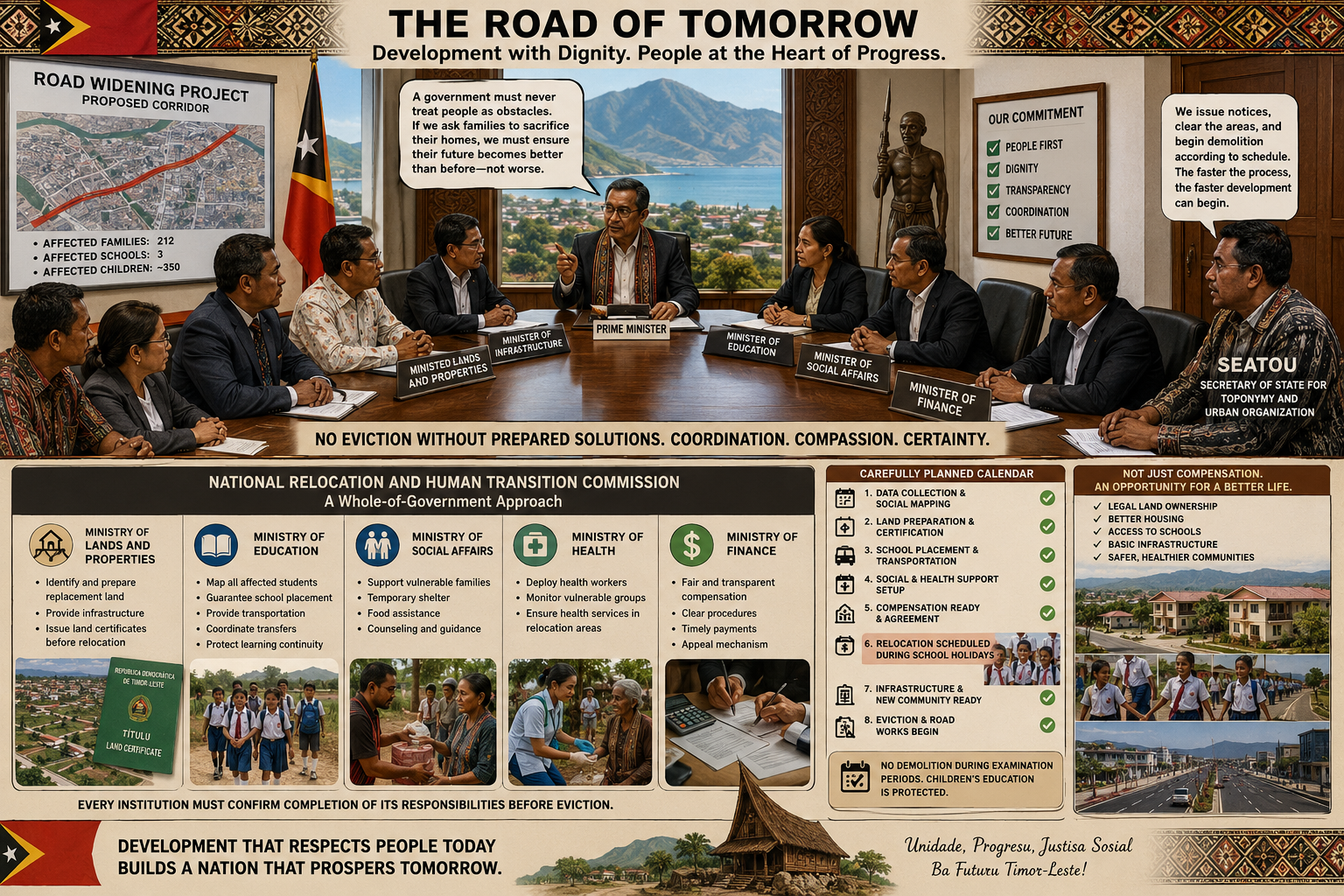
There is an old story told in a distant land, far beyond the seas, about a nation that once faced a difficult choice between development and human suffering.
The capital city of that land had grown rapidly. What were once narrow roads built for carts and bicycles had become crowded arteries filled with cars, buses, motorcycles, ambulances, and trucks. Every morning, traffic stretched endlessly across the city. Workers arrived late. Children spent hours on buses before reaching school. Emergency vehicles became trapped in congestion. Businesses suffered. Pollution increased. Frustration grew.
One day, the Ministry of Infrastructure presented a proposal before the Council of Ministers: a massive road-widening project intended to transform the capital and prepare the nation for the future.
Also present at the meeting was the Secretary of State for Toponymy and Urban Organization — an institution responsible for urban organization and territorial management.
The Prime Minister listened silently as engineers projected maps onto a large screen.
The Prime Minister nodded slowly.
The room fell quiet for a moment.
The Prime Minister remained silent for several seconds.
Then he asked the question that changed everything.
The room became still.
The Secretary of State for Toponymy and Urban Organization immediately responded.
The Secretary lowered his eyes toward the documents on the table.
For a moment, the Prime Minister said nothing.
Then he spoke slowly, his voice calm but firm.
"A state institution must never behave like a lone cowboy acting independently of the Government, as though development were a personal performance or a one-man show. Government exists precisely because national problems require coordination, wisdom, and shared responsibility." — The Prime Minister
He turned toward the ministers assembled around the table.
"A government must never speak about development as though people are obstacles standing in its way. The people are the purpose of development." — The Prime Minister
He walked toward the large map displayed at the center of the room.
"If we ask families to sacrifice their homes for the future of the nation, then the nation must ensure that their future becomes better than before — not worse." — The Prime Minister
That same afternoon, the Government created what became known as the National Relocation and Human Transition Commission.
And the Prime Minister made another thing absolutely clear:
"No institution shall conduct evictions independently, without coordination with the Government as a whole. Urban organization is not merely about removing structures from land. It is about organizing human life with dignity." — The Prime Minister
The Commission was not composed only of engineers.
A New Architecture of Responsibility
The Secretary of State for Toponymy and Urban Organization remained responsible for the urban planning and road alignment aspects of the project, but every operational step now required coordination with other ministries and institutions.
The Ministry of Lands and Properties was tasked with identifying and preparing replacement land before a single eviction notice could be issued. Every plot had to be legally surveyed, connected to basic infrastructure, and accompanied by official land certificates ready to be handed directly to affected families.
The Ministry of Education was instructed to map every school-age child affected by the project. Transfer mechanisms were simplified. Transportation routes were reorganized. New school placements were guaranteed before relocation began. Special attention was given to students preparing for national examinations.
The Ministry of Social Affairs established temporary transition assistance programs for vulnerable families, widows, elderly citizens, and persons with disabilities. Food assistance, temporary housing support, counseling services, and relocation teams were prepared months in advance.
The Ministry of Health deployed community health workers to relocation areas to monitor vulnerable individuals during the transition period.
The Ministry of Finance was instructed to create a transparent compensation mechanism with clearly published timelines, procedures, appeal systems, and payment guarantees.
The Prime Minister gave another instruction that surprised many officials.
"No eviction shall occur before every institution confirms that its responsibilities have been completed." — The Prime Minister
And so the calendar itself became part of the strategy.
Demolitions were prohibited during examination periods. Families with school children were relocated during school holidays to minimize educational disruption. Elderly citizens living alone were prioritized for early assistance. Families received relocation schedules months in advance instead of sudden notices.
Entire neighborhoods were visited repeatedly by social workers, engineers, teachers, and legal officers who explained every step of the process.
Development as Opportunity, Not Only Loss
But perhaps the most remarkable part of the story was this: the Government did not approach relocation merely as compensation for loss. It approached it as an opportunity for social improvement.
Many families who had once lived without legal documentation suddenly became legal landowners for the first time in their lives.
Some moved into organized communities with better drainage, electricity, water systems, schools, clinics, and public transportation.
Children who once walked through floodwaters to reach school now traveled on paved roads.
Families who had feared homelessness began building stronger homes than the ones they had lost.
The costs were enormous.
Some ministers worried openly about the financial burden.
But the Prime Minister answered them with words that were later remembered for generations.
"There are expenses that weaken a nation, and there are expenses that define its moral greatness. Money spent protecting the dignity of the people is never wasted." — The Prime Minister
What the People Remembered
Years later, the widened roads transformed the capital. Traffic improved. Commerce flourished. Ambulances moved freely. New businesses emerged.
But strangely, when people spoke about the project, they did not speak first about the asphalt, the bridges, or the traffic flow.
They spoke about the way the Government treated the people.
They remembered that in a difficult moment, development did not arrive carrying only tractors and demolition orders. It arrived carrying certificates, school placements, social support, planning, coordination, and dignity.