
The Sad Reality of the Portuguese Language in Timor-Leste: An Ongoing Pedagogical Disaster
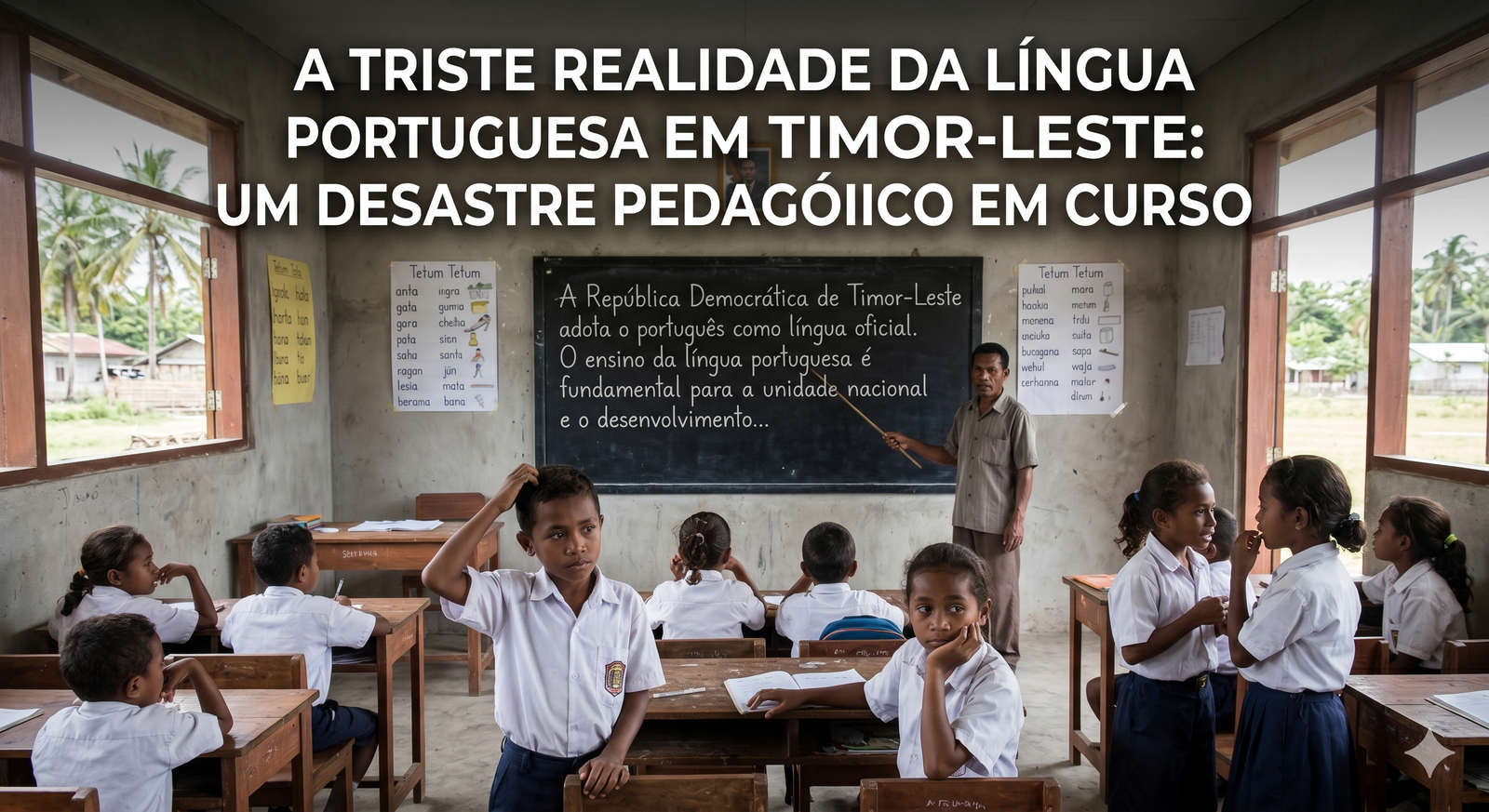
Decades after independence, Timor-Leste finds itself at a linguistic crossroads that reflects not only controversial political decisions, but also a profound disconnect between the aspirations of the elite and the real needs of the population. The Portuguese language, elevated to official status alongside Tetum, has become a source of national embarrassment and an obstacle to the country's educational development.
An Elite Decision Without Popular Consultation
The choice of Portuguese as an official language was a decision made by the Timorese political elite, without the people being properly consulted. Had the population been given a voice, it is plausible that the majority would have chosen English or even Bahasa Indonesia — languages with greater regional and international relevance. This top-down imposition created, from the outset, a gulf between political aspirations and the social reality of the country.
The problem was compounded by the absence of a serious commitment — on the part of both the Government and civil society — to recover the linguistic ground lost during the 24 years of Indonesian rule, a period during which the Portuguese language virtually disappeared from the Timorese sociocultural map. Portuguese is taught, certainly, but without the strategies, efforts, and incentives suited to the local mentality and sociocultural environment, resulting in inefficient and unmotivated learning.
The Contrast with Other Examples
The ineffectiveness of Portuguese language teaching becomes even more glaring when contrasted with other success stories. Cuban doctors, invited to establish and sustain the general medicine programme in Timor-Leste, managed in less than a year to bring medical students to fluent command of Spanish — both in reading and oral expression. This contrast makes clear that the problem does not lie in the Timorese capacity to learn, but rather in the pedagogical approach adopted for Portuguese.
A Landscape of Laughter and Pedagogical Disaster
The fanaticism surrounding the Portuguese language — where pressure for its maintenance as the official language and medium of instruction remains unquestioned — is transforming Timor-Leste's linguistic landscape into a stage of absurdity and an outright pedagogical disaster. One need only browse the national newspapers and read the headlines in Portuguese to collapse into fits of laughter that can last for hours, so numerous are the basic errors of grammar and syntax.
In universities — including the Catholic University, which proudly displays the slogan "investing in the Portuguese language" — one witnesses the sorry spectacle of students and professors who, encouraged or even compelled to express themselves in Portuguese, seize the opportunity to give free rein to linguistic creativity, resulting in the unapologetic display of horrendous grammatical errors. This is in addition to the damage caused by limited access to teaching materials in languages that are more readily understood.
Tetum: A Squandered Opportunity
Paradoxically, Tetum shares the same fate as Portuguese. There has never been any visible effort by the Government to standardise it properly. Today there are at least four different versions: the Tetum with the government's official orthography, the Tetum of the Catholic Church, the Tetum of Dr. Geoffrey Hull, and the Tetum of the Brazilian churches. This fragmentation prevents the natural development of the country's native national language.
A Call for Reason and Concrete Action
It is urgent to recognise that national prestige without restrictions and practical guidance kills productivity and good sense. We propose a radical paradigm shift: grant Tetum a period of 30 to 50 years to consolidate, enrich, and develop as a de facto national language — with serious investment in its standardisation, lexical development, and production of teaching materials.
Without abandoning Portuguese, during this period English should assume the role of the international language of higher education and scientific communication, while Portuguese could be maintained as a language of cultural prestige, but without the pressure of being a compulsory language of instruction.
The future of Timor-Leste cannot continue to be held hostage to linguistic decisions that serve political ego more than the real development of the country. It is time to choose pragmatic effectiveness over misdirected linguistic romanticism.