
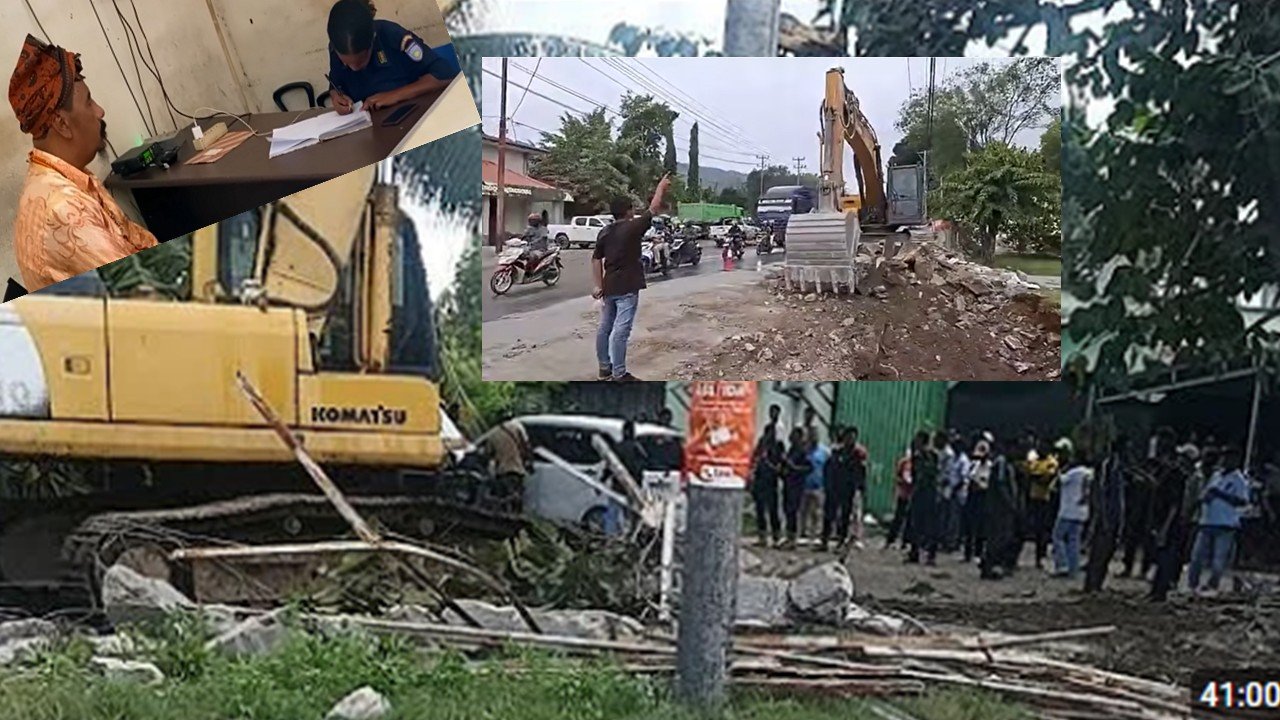
In the streets and neighborhoods of Dili today, there is a silent anxiety spreading from house to house. Families wake up every morning wondering whether today will be the day when the sound of heavy tractors arrives at their gate. Mothers gather their belongings in uncertainty. Fathers stand outside their homes, looking at walls they built with years of sacrifice, fearing that soon they may become nothing more than piles of broken concrete and wood beside the road.
For many citizens of Timor-Leste's capital, especially those affected by the administrative evictions carried out by SEATOU since mid-2023, life has become a state of permanent insecurity.
Waves of Displacement
These are not isolated cases. They are part of repeated waves of evictions that have affected countless families. Some people have already seen their homes demolished. Others continue waiting in fear, unsure of when their turn will come. Many were not offered replacement land. Most were not provided replacement housing. Some families, after losing everything, were reportedly loaded onto trucks and transported toward municipalities without a clear destination or long-term solution.
Yes, there is mention of compensation. But compensation itself has become another source of confusion and anguish. The amounts often do not reflect the years of investment and sacrifice made by families. The procedures are unclear. The timing is uncertain. Transparency appears insufficient. For people who have lost their homes, uncertainty is itself another form of suffering.
A home is not just wood, cement, and zinc roofing. A home is memory. Stability. Security. Belonging. It is where children grow up, where families survive difficult times, where the elderly feel protected, and where people dream about the future.
What the People Expect from Their Government
SEATOU is not a criminal organization. It is not a gang. It is not the Mafia. It is a government institution — part of the IX Constitutional Government of Timor-Leste. As such, the people naturally expect it to act not merely with authority, but with wisdom, humanity, coordination, and compassion.
A government is supposed to represent the highest level of organized intelligence and coordination within a nation. The Council of Ministers exists precisely to ensure that state institutions work together harmoniously for the benefit of the population. Institutions responsible for land administration, housing, social support, infrastructure, and territorial planning should not function as disconnected entities acting independently of the human consequences of their decisions.
The people believe — and rightly so — that before any family is removed from its home, the government should already have prepared alternative land for relocation. Not empty promises. Not vague future possibilities. Real land. Real locations. Properly surveyed. Legally secured. With certificates already issued through the competent authorities responsible for Lands and Properties.
This is what people expect from a functioning state.
Development Cannot Leave Citizens Behind
No reasonable citizen opposes national development. The people of Timor-Leste understand the importance of roads, drainage systems, urban planning, public infrastructure, and modernization. They understand that development sometimes requires sacrifice. But sacrifice cannot be demanded only from the poor while the state offers little certainty in return.
Development that leaves citizens abandoned on the roadside cannot easily be called development for the people.
Government propaganda often speaks about serving the population and building a better future for the people. Yet many affected citizens ask a painful question: which people? The real people who are suffering today? Or some imaginary people of an undefined future?
Toward a Humane Model of Social Compensation
Right now, the government has a historic opportunity to demonstrate that its declarations are sincere. This moment could become proof that national development is truly centered on human dignity.
For this reason, many believe that the current approach should move beyond the narrow concept of simple monetary compensation. Instead, Timor-Leste could adopt a broader and more humane concept of social compensation — similar to approaches promoted during the administration of Joko Widodo in Indonesia, where development projects were often accompanied by relocation support, resettlement planning, and practical benefits intended to protect the dignity and continuity of affected families.
Certainly, such an approach would carry greater financial implications for the Government. Preparing replacement land, building relocation areas, issuing legal land certificates, creating basic infrastructure, and supporting families during transition periods would require significant public investment. However, whatever the financial cost may be, such expenditures cannot and should not be viewed as wasteful spending. On the contrary, they would represent one of the most commendable and humane investments a government can make in its own people.
The Cost of Getting It Wrong — and the Promise of Getting It Right
A state is ultimately judged not only by the roads it builds or the buildings it inaugurates, but by the way it treats its citizens during moments of vulnerability and sacrifice. If national development demands that certain communities give up their homes for the broader public interest, then the nation also carries a moral responsibility to ensure that those sacrifices become the beginning of a better life — not the beginning of prolonged suffering.
Without proper relocation and social protection, evictions can condemn families to hours, days, weeks, months, or even years of uncertainty, poverty, instability, and emotional trauma before any possibility of recovery emerges. Children's education may be interrupted. Livelihoods may collapse. Social networks may disintegrate. Entire communities can lose the sense of security that took decades to build.
But with a humane and well-planned compensation and relocation system, the same process could instead become an opportunity for renewal and improvement. Families could transition into safer housing, more organized communities, and legally recognized land ownership. The trauma of displacement could be transformed into hope, stability, and social advancement. What could have become a source of bitterness for generations might instead become a lasting symbol of responsible governance and compassionate leadership.
Such actions would not be forgotten. Generations to come would remember that when the state asked people to sacrifice for national development, it did not abandon them afterward. It stood beside them, protected them, and ensured that development truly served the real people of Timor-Leste.
Trust Is the Foundation
When homes disappear without credible alternatives, something deeper than property is destroyed: trust.
And yet, despite the fear and disappointment, hope has not completely disappeared.
The people still hope that the Government will listen. They still hope that wisdom will prevail over bureaucracy. They still hope that national development can become truly inclusive and compassionate. They still hope that the state will remember that the purpose of development is not simply to build roads and structures, but to improve the lives of real human beings.
If the Government truly seeks development for the benefit of the people of Timor-Leste, then this is the moment to prove it — not to an imaginary future population, but to the real people who are suffering now, worried now, and waiting now.